




Astribot S1
Any2Act: Scaling In-Context Robot Learning
from Heterogeneous Demonstrations
- 1The University of Hong Kong
- 2Tsinghua University
- 3Peking University
- 4Shanghai Qi Zhi Institute
- 5Galbot
- arXivRead paper
- CodeComing soon
- ModelComing soon
- 1.2M
- real robot trajectories
- 10K
- tasks in pretraining
- 57.5%
- success on unseen tasks in the real-world evaluation
Abstract
Robot in-context learning (ICL) enables a policy to perform unseen tasks by following contextual demonstrations, without task-specific fine-tuning. This is increasingly valuable as large language models reasoning at low frequency can specify tasks through demonstrations and delegate high-frequency execution to such a policy. However, methods conditioned on human videos are bounded by scarce human–robot pairs, while those conditioned on robot demonstrations accept only one or two source types at limited scale. We present Any2Act, a foundation model for robot ICL. Our key insight is that a demonstration should be expressed in the camera layout and action space of the robot that performs it (the executor), not of whoever provided it (the demonstrator). This unified embodiment-grounded representation decouples learning to follow from admitting a new source. Any2Act learns to follow once, from robot-to-robot pairs that already take this form in 1.2M real trajectories spanning 10K tasks. Human videos, simulation, UMI, and other robots are then translated into this representation, and source-routed adapters trained on only a few hundred pairs each absorb the residual gap while the pretrained model stays frozen. For long horizons, a training-free tracker feeds only the demonstration window around the executor’s progress, bounding the context and rolling back to redo failed steps. From a single demonstration, Any2Act achieves 57.5% success on unseen tasks without fine-tuning, exceeding VLAs fine-tuned on 50 demonstrations per task; other demonstrators retain 74–91% of the success achieved with the executor’s own demonstrations.
Method
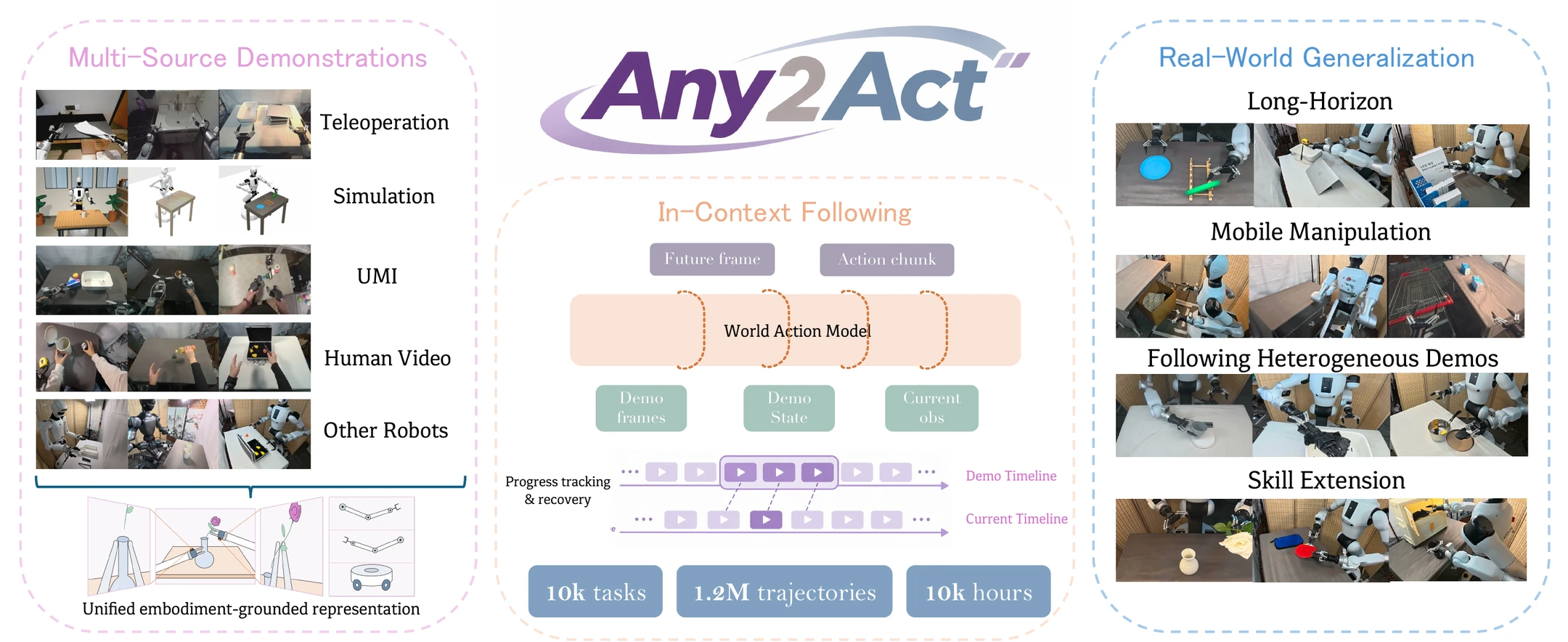
Any2Act decouples learning to follow demonstrations from admitting new demonstration sources by mapping heterogeneous inputs into the executor robot’s representation.
Embodiment-grounded representation
Demonstrations from teleoperation, simulation, UMI, human video, and other robots are translated into the camera layout and action space of the executor.
Source-routed adapters
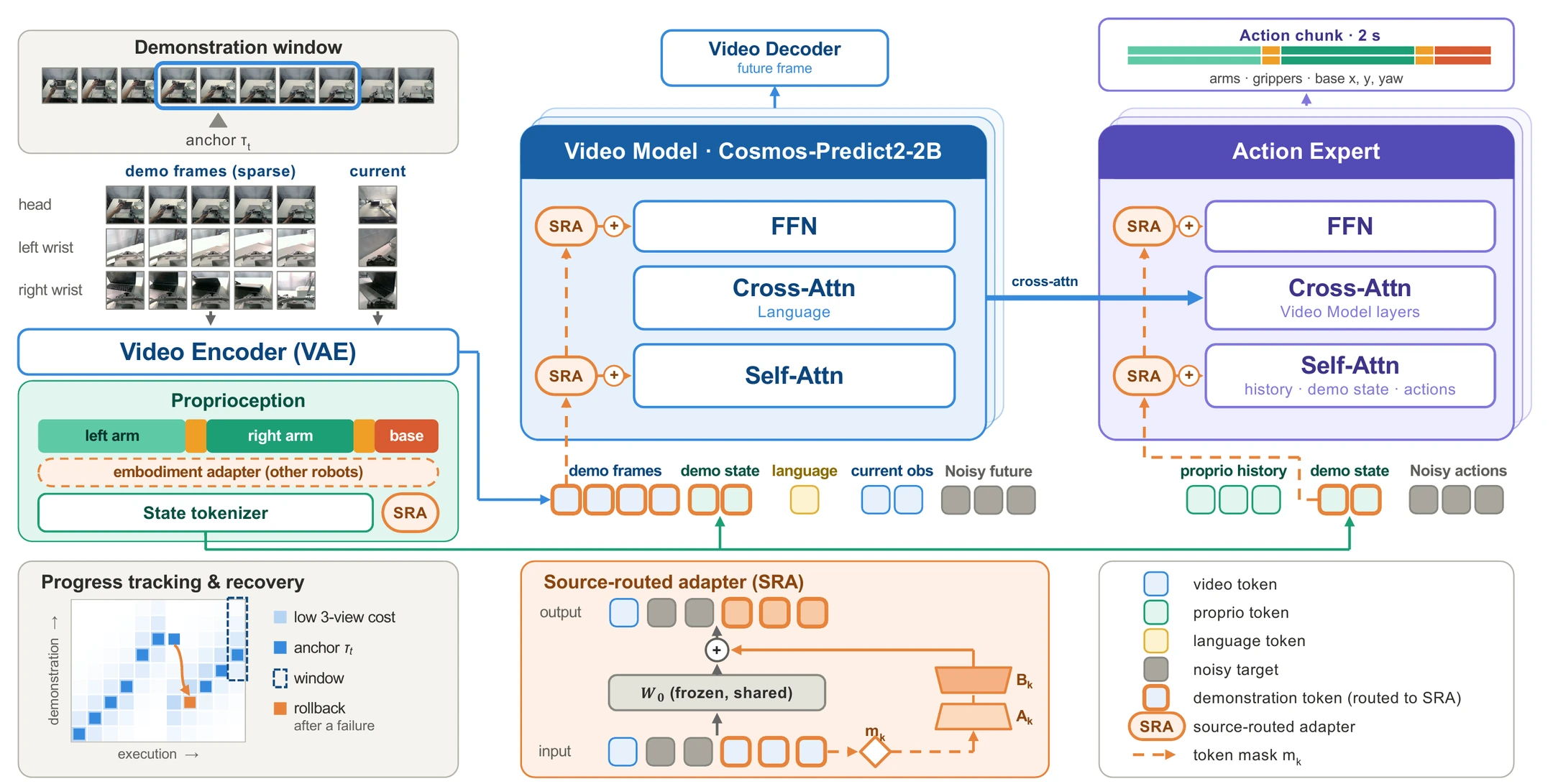
Source-routed adapters trained on a few hundred pairs per source process only the demonstration tokens from their corresponding source to absorb the residual domain gap while keeping the pretrained model frozen.
Progress tracking and recovery
At inference, a training-free progress tracker supplies a short demonstration window around the executor’s current progress and rolls the window back to retry failed steps on long-horizon tasks.
Model architecture
Heterogeneous Demonstrations
Galbot rollouts at 5× speed. The Demo input inset shows a same-task demonstration aligned to the rollout by action phase.
Spirit Moz1
Brush a keyboard
Human (ego2sim)
Prepare eggs in a pot
UMI
Stow a tape measure and close a laptop
Simulation
Place a folded umbrella in a basket
Simulation
Place a paper ball in a container
Real-World Demonstrations
Ten complete Galbot tasks, shown from a fixed third-person camera at 5× speed.